Transe
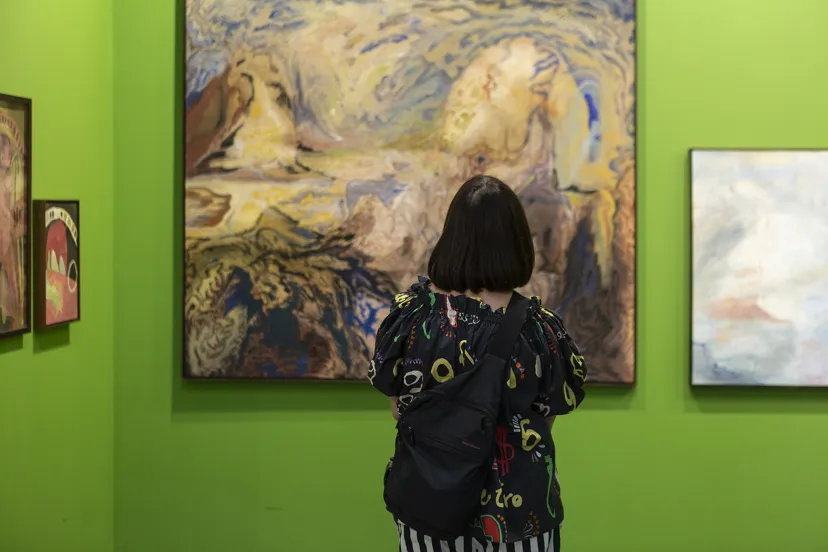
Transe, curated by Lucas Albuquerque, proposes an immersion into an ambiguous territory where figuration dissolves and the non-figurative gains form. It is a constantly shifting visual field where gesture, body, memory, and sensitivity intertwine in an undisciplined manner. The exhibition brings together new works by five artists from diverse backgrounds and trajectories: Caio Carpinelli (1993, São Paulo, Brazil), Emilia Estrada (1989, Córdoba, Argentina), Fernão Cruz (1995, Lisbon, Portugal), Marina Woisky (1996, São Paulo, Brazil), and Marlan Cotrim (1993, Goiânia/Recife, Brazil).
"Transe is born from the desire to bring together artists who question both figuration and abstraction in what I call non-figuration, as a double negation," says Lucas Albuquerque. "The works in this section do not aim to fix forms or meanings. On the contrary, they act as passages. They are fields of energy where image, body, history, and matter are always in transit, flowing beyond the binary pendulum between figuration and abstraction," explains the curator.

Portrait of Lucas Albuquerque. © Gabi Carrera
"Transe embodies the spirit of Routes: provoking displacements, promoting encounters, and imagining possible futures," says Fernanda Feitosa, director of SP-Arte.
More than a project about style or trend, Transe presents itself as a state of sensitive attentiveness, a crossing. By gathering artists whose practices escape the rigid categories of contemporary art, Lucas Albuquerque proposes a visual and political experience that resonates with the very proposal of SP-Arte Routes: to displace, transpose, and reinvent. "These artists create works that inhabit zones of ambiguity, like a whisper between what is said and what escapes. This is the power of Transe," concludes Albuquerque.
The Artists and Their Works
Caio Carpinelli (São Paulo, Brazil)
Yehudi Hollander-Pappi

Retrato de Caio Carpinelli. © Divulgação
Born in 1993 in São Paulo, Carpinelli is an artist whose trajectory unfolds at the intersection of painting, drawing, and physics. His work dialogues with the metaphysical tradition and investigates the limits of abstract language, using black as a central element; not as an absence, but as an active matter that invites light and perception. Carpinelli creates surfaces that absorb and reflect, tensioning the gaze and provoking intense emotional reactions. His technical mastery, combined with deep poetic research, transforms the minimal gesture into a transcendent experience. Currently, the artist is represented by gallery Yehudi Hollander-Pappi in São Paulo.
In Transe, Carpinelli presents a painting that unfolds into space, incorporating three-dimensional elements like columns and voids. The work is inspired by the double-slit experiment, which demonstrates how light behaves differently when observed, articulating circular forms, slits, and ancestral black pigments in an installation that activates the gaze. By exploring the ambiguity between presence and absence, visible and invisible, his proposal invites the public to a sensory and reflective experience where time and perception continuously shift.

Caio Carpinelli, "Untitled", 2025. © Estúdio em Obra
Emilia Estrada (Córdoba, Argentina / Rio de Janeiro, Brazil)
Portas Vilaseca

Portrait of Emília Estrada. © Renato Mangolin
Born in 1989 in Córdoba, Argentina, Emilia Estrada has been living and working in Rio de Janeiro since 2014. An immigrant artist of Palestinian descent, her work is intersected by issues of displacement, ancestry, and historical construction. A graduate in Visual Arts from the Universidad Nacional de Córdoba and the Universidade Federal Fluminense, she was also a grantee of the Contemporary Artistic Practices program at EAV Parque Lage. Her production questions the gaps in official history and is articulated from the friction between archives, iconographies, and cartographies, proposing critical readings of science and representation. The way her Latino-Palestinian origin resonates in research that tensions the colonization of the skies and the land places her poetics in a larger constellation of artists deconstructing visual hegemonies. Currently, she is represented by the gallery Portas Vilaseca in Rio de Janeiro.
In Transe, Emilia presents a series of observational drawings of the moon’s surface made with charcoal on linen, silk, and velvet. The textures of these fabrics echo sensory and symbolic landscapes, unfolding into visual maps where figure and abstraction merge. The gold leaf frames, inspired by ancient cartographies, do not function as ornament but as a narrative structure guiding the reading of the image. Her works instill a contemplative and poetic rhythm, where the Moon—already colonized by scientific and imaginary narratives—is revisited under a migrant, fable-like and political gaze.

Emilia Estrada, "Observação à sombra alta n2", 2025. © Courtesy
Fernão Cruz (Lisboa, Portugal)
Cristina Guerra

Portrait of Fernão Cruz. © Nuno Fox
Born in 1995 in Lisbon, Fernão Cruz is one of the leading voices of the new generation of Portuguese artists. A graduate in Painting from FBAUL, he also studied at the Faculty of Fine Arts of the University of Barcelona. His practice spans painting, sculpture, assemblage, and installation, with an emphasis on themes such as memory, desire, mourning, and identity. His work is part of important collections like the Calouste Gulbenkian Foundation and Culturgest, and has been exhibited in prominent institutions like CAM Gulbenkian. What marks his production is the power of an intimate and sensitive investigation of the human condition, conducted through hybrid forms and materials inhabiting the everyday. Currently, he is represented by gallery Cristina Guerra in Lisbon.
During an artistic residency in São Paulo, Fernão Cruz developed for Transe a set of sculptures exploring the concept of "box" as a symbol of displacement and containment. Using materials like cardboard, fabrics, thrift store objects, and construction elements, the artist fictionalizes time itself by expanding narratives that merge his personal experiences with those of the former owners of each recovered object. His boxes are at once fragile and dense, revealing hidden stories and compressed emotions. The sculptures propose a poetics of transportation, evoking physical and psychic displacements, and questioning the very circuit of art as merchandise and language.

Fernão Cruz, "Queda", 2025. © Estúdio em Obra
Marina Woisky (São Paulo, Brazil)
Almeida & Dale

Portrait of Marina Woisky. © Ana Pigosso
Marina Woisky, born in 1996 in São Paulo, is a visual artist and a master's candidate in Visual Arts at UNESP. Named by ArtReview as one of the promising names in contemporary art in 2025, she also participated in the 38th Panorama of Brazilian Art (MAM/SP) in 2024. Her work moves between photography, sculpture, and painting, utilizing a unique technique that transforms images of ancient ornaments into metamorphic bodies through sewing, fabric printing, and filling with mortar, acrylic blanket, and bronze. Her work stands out for its ability to evoke images from an undefined time and space, where reality and imagination merge. Currently, she is represented by Almeida & Dale gallery in São Paulo.
In Transe, Marina presents works that unfold as fantastic landscapes, evoking creatures and environments with no certain origin or destination. The forms generated from the compression and distortion of ornamental images gain tactile presence and symbolic density. In a play between the two-dimensional and three-dimensional, her work questions the status of the image and proposes a visual experience that is also temporal: requiring time for observation and availability of gaze. In her research, time acts as an agent of aesthetic and conceptual transformation, generating bodies that seem suspended between memory, myth, and matter.

Marina Woisky, "Cachorros em C", 2025. © Estúdio em Obra
Marlan Cotrim (Goiânia / Recife, Brazil)
Amparo 60

Portrait of Marlan Cotrim. © Guilherme Allain
Born in 1993 in Goiânia and currently living in Recife, Marlan Cotrim is a transdisciplinary artist with a background in dance and a degree in Fashion Design. Her work traverses painting, performance, video, dress, textile, and sculpture, articulating a poetics of the body in constant displacement. After a decade dedicated to dance, Marlan began her visual production with torn tapestries as a gesture of symbolic healing, later expanding her research to paintings that tremble, blur, and dissolve. Inspired by thinkers like Édouard Glissant and Nêgo Bispo, her production addresses themes such as territory, ancestry, transition, and germination. Currently, she is represented by the Amparo 60 gallery in Recife.
For Transe, Marlan presents works from the series "Corpographies in transit," which problematize the idea of boundary—geographical, identity, and pictorial—through blurs, traces, and liquid gestures. Working with fabrics, paints, gauzes, and charcoal, her paintings evoke landscapes that move and transform. The piece "In this part of the path where we become water" condenses her proposal of an embodied painting that dissolves and recomposes into new forms of existence. Marlan creates images in transit, rejecting fixed definitions and proposing an aesthetic of affection, fluidity, and coexistence, where the body is river, forest, breath, and silence.

Marlan Cotrim, "É na descida da ladeira tem água que molha pé", 2025. © Danilo Galvão