SP-Arte 2022
SP–Arte welcomes 25 thousand people at the Bienal Pavilion, attracts new audiences and moves the market
The 18th edition of the leading art fair in the Southern Hemisphere took place from April 6th to 10th, in São Paulo, featuring large audience and successful sales
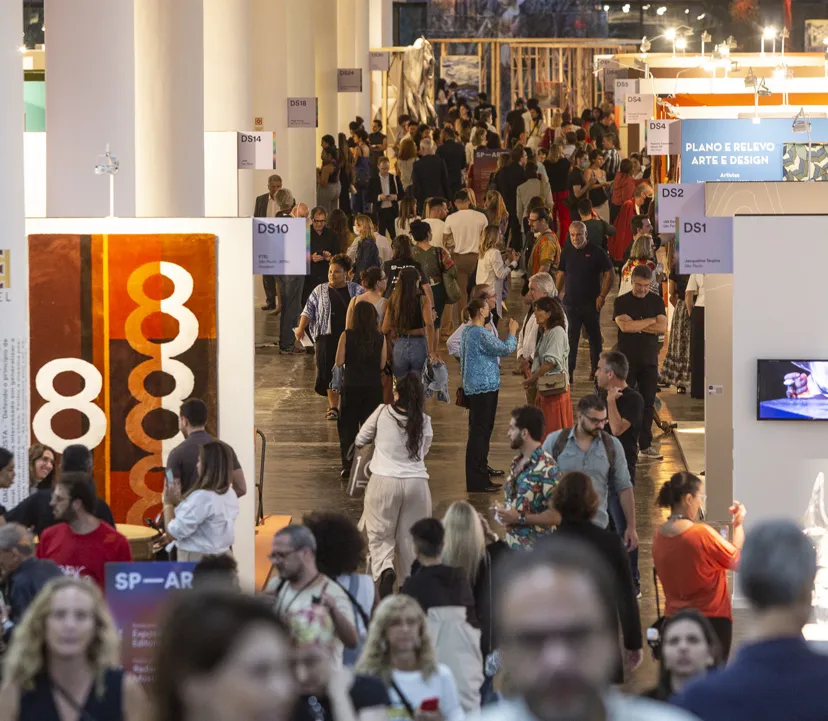
Every new edition, SP–Arte, São Paulo’s International Art Festival, renews itself, innovates and evolves, anticipating trends and drawing the attention of new audiences. This was even more evident for the nearly 25 thousand visitors that were attracted by the 18th edition of the event, which took place from April 6th to 10th at the Bienal Pavilion, in São Paulo, gathering 133 art and design galleries, in addition to publishers and special projects.
Among the innovations of this edition, the highlight was the new Radar SP–Arte sector, which gave greater visibility to independent initiatives, NGOs, and artists without commercial representation, curated by Felipe Molitor. The exhibition Arte Natureza: ressignificar para viver, curated by Ana Carolina Ralston, also attracted public attention. At the same time, there were talks (Talks program at Arena Iguatemi), guided tours, book launches, as well as the SP–Arte Weekend, which enlivened the city’s cultural itinerary during the two weekends preceding the fair, offering the public multiple activities as openings and closings of exhibitions, tours and celebrations in several galleries, cultural centers, and art-related institutions.
According to most of the exhibitors, the return of the fair to the Bienal Pavilion, after two years, was marked by enthusiasm and good business. At the same time that the Fair enabled new business deals to be made, catalyzing and bringing together the market as a whole, it succeeded once again in attracting new types of buyers and collectors, reinforcing its importance and credibility with the more traditional groups. One of the most striking points for the exhibitors was the greater diversity represented at the event and the amount of new customers and public visiting the fair: young, diverse, curious, and ethnically plural.
The commercial success of the fair was acknowledged by the gallery owners, such as Luisa Strina, who celebrated the sales of 21 works, considering the fair an excellent period for negotiations. The gallery owner pointed out the formation of a new generation of collectors: “we noticed a new public at the fair, younger and well qualified, who try to learn about the subject, visit museums, and do research”. Myra Babenco, from Raquel Arnaud Gallery, also considered the fair a great opportunity for sales and attracting new clients. “We made at least five relevant sales of pieces by important artists such as Julio Vilani, Waltercio Caldas, Carla Chaim, Iole de Freitas, Célia Euvaldo and Cruz-Díez.”
Ricardo Rinaldi, director of Kogan Amaro gallery, says: “very good public, very busy edition every day. The best of all in terms of results (he participates since 2018). In terms of numbers, we had about 20 works sold. It is always a good occasion for innovations, so we presented artworks in NFT to the market, which were very well received.”
Among secondary market gallerists, Antônio Almeida, from Almeida & Dale, comments: “In terms of audience, this was an excellent SP–Arte, with high attendance, young clients and many young people buying”. In terms of sales, the evaluation is also positive: “we sold well, it was the best edition ever. The fair has settled very well in the building, allowing customers to map it, with wide aisles and distance to appreciate the artworks, with excellent pieces on display”.
Paulo Darzé, from Paulo Darzé Gallery, in Salvador, who brought to the fair only works by the artist Genaro de Carvalho, from Bahia, sold 90% of his booth. “In the first hours of the opening day of the fair I had already sold 80% of the booth. It was excellent”, he celebrates.
In the Design sector, making its debut at the event, Wentz appreciated the 18th edition very well, with an excellent audience for the brand and contacts. “We noticed a very nice interest from the public, an energy of recovery, and we think it’s very nice that Design is occupying the first floor of the Pavilion, giving more visibility to the sector,” declares Cintia Wentz.
Other exhibitors from the Design sector agree with the statement. Karoline Bessa, from ,ovo, which celebrates 30 years this year and launched a new collection at the event, says: “good attendance, great institutional visibility and a trigger for new and future sales”. From Etel, Camila Carmona comments, “We didn’t sell at the fair, but it always contributes to attracting customers. In our area, the sales happen afterwards, in the store. It is a great branded exposition, new clients that we end up getting here and understand a little more about the brand reach.”
For Mônica Novaes Esmanhotto, from Casa do Povo, the benefits go beyond the Fair: “We had three goals for this edition: to sell the works from Comum Presença collection that we made especially for the occasion, to support the renovation of our building; to expand our network of regular supporters; and to promote Casa do Povo by engaging more people in the institution’s mission. We can say that we were very successful on all three fronts”. Paula Signorelli, who leads Pivô, reinforces this perspective: “It was a very important moment for Pivô. Besides the good sales, it was very important to be in contact with people who didn’t know our work, our kind of research and residency project, and who collaborated by donating materials and buying products”.
According to Fernanda Feitosa, founder and director of SP–Arte, the post-edition mood is festive. “We are very happy with this edition, which had a special feeling of reunion and return to the traditional Bienal Pavilion, a place we have occupied since 2005. In addition, we were able to carry out a new project, the result of an earlier provocation we made, in 2020, but that could now be accomplished in person, which was the Radar SP–Arte, a project of independent artistic and institutional mapping, bringing new agents to the art scene in an event with such visibility, as happened to Solar dos Abacaxis, Casa Chama, Casa do Povo. I am very proud of my extraordinary team of architecture, design, communication, production, curatorship, photography and video for having accomplished a historic edition, with great impact on the public and the national and international press. It is not easy to sell out tickets, even less to mobilize such a qualified and engaged public around art.”
Sponsorships
SP–Arte keeps a close collaboration with its sponsors, who share the ambition of creating a global platform for the exchange of ideas that propel the art world. Historically, for more than 15 years, the Fair has had Vivo, Rede/Itaú and Iguatemi as its master sponsors, and this year they were joined by Orizon VR, which was responsible for the neutralization of the event’s carbon emission, and Unipar. SP-Arte has also the sponsorship of Tiffany & Co. Liberty Seguros, Beck’s, Chandon, Terrazas de los Andes as official drinks, besides several fundamental partners that make the event possible, such as Café Orfeu, Capim Santo restaurant, Le Pain Quotidien, Finarte Seguros de Arte, Água na Caixa, Jardineiro Fiel, ,ovo and Kamy.
Security measures
SP–Arte adopted the appropriate security measures so that the visitation could take place in the best way possible. Once again, the ticket purchase was made online and by appointment. For access to the event, it was necessary to present a proof of being fully vaccinated against Covid-19, according to municipal and state determinations.
High-resolution images
18th SP–Arte views: https://flic.kr/s/aHBqjzJK4X
Art galleries: https://flic.kr/s/aHBqjzG7DT
Design galleries: https://flic.kr/s/aHBqjzG8m3
Art publishing houses: https://flic.kr/s/aHBqjzG9MG