Press Release SP-Arte Rotas 2026
SP-Arte Rotas 2026 expands its dialogue with Latin America in its 5th edition
In addition, the art fair presents curatorial projects from all regions of Brazil
Images at: www.flickr.com/photos/sp-arte/albums/
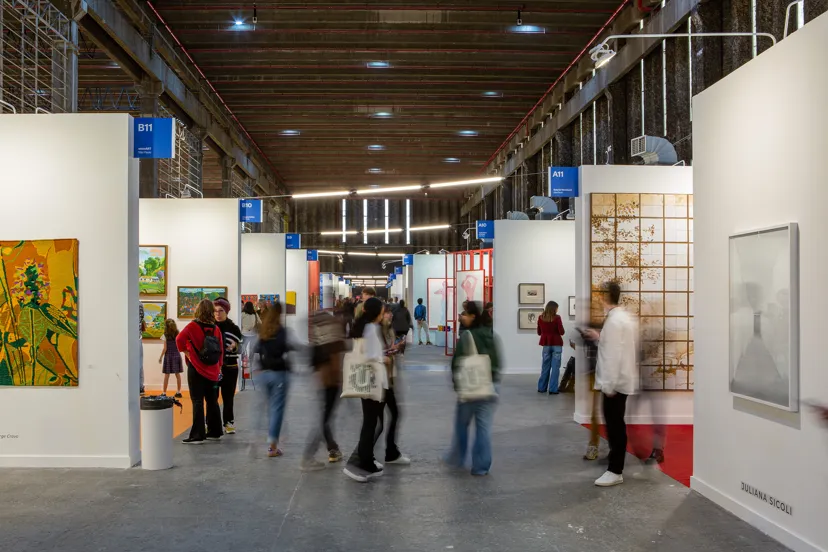
SP-Arte Rotas reaches its 5th edition with 70 art galleries, as well as invited museums and special projects, from August 26 to 30 at ARCA, in São Paulo. Held since 2022, the fair reaffirms its purpose of delving into Brazilian art, with special attention to artists from outside the Rio de Janeiro–São Paulo axis.
At SP-Arte Rotas, each booth presents a new project developed especially for the event. These projects often shed light on artists and movements known only regionally, as well as talents expected to emerge on the art scene in the coming years. This edition of Rotas strengthens its connections with neighboring Latin American countries, bringing galleries from Uruguay (Sur), Argentina (Barro, Isla Flotante and W–galería), and Colombia (Casa Zirio), as well as Italy’s Orma, continuing the expansion that began in 2025. Making their debut at the fair are Apartamento 61, Boi, Casa do Povo, Casa Seva, Casa Triângulo, Errol Flynn, Gruta, Jaider Esbell, Lucas Recchia, Midlej, Ocupá, Pórtico and Refresco.
Among the participants are established galleries such as Almeida & Dale, Casa Triângulo, DAN, Flexa, Galatea, Gomide&Co, Luciana Brito, Marilia Razuk and Vermelho. They share the corridors of ARCA with galleries from across Brazil, including Lima, from São Luís do Maranhão; Cave and Leonardo Leal, from Ceará; Marco Zero, from Pernambuco; Paulo Darzé and Midlej, from Bahia; and Cerrado and Karla Osório, from Brazil’s Central-West region.
This year, the fair continues to make room for special projects. One of them is Sertão Negro, an artist studio-school founded by Dalton Paula in Goiânia, which also celebrates five years of activity in 2026. Galeria Ocupá, meanwhile, is a space that seeks to build bridges between Rio de Janeiro’s South Zone and artists from the city’s peripheral territories; and Galeria Jaider Esbell de Arte Indígena Contemporânea is an independent collective space in Boa Vista, Roraima, focused on the work of Indigenous artists. Casa do Povo, in turn, presents a group of paintings made by Maxakali artists from Aldeia-Escola-Floresta — a project in the Itamunheque region, in the municipality of Teófilo Otoni, conceived by Sueli and Isael Maxakali.
This year, the artistic direction is led by Brazilian curator, writer and researcher Bernardo Mosqueira. Based in New York, Mosqueira has been the founder and artistic director of Solar (formerly known as Solar dos Abacaxis), in Rio de Janeiro, since 2015. He was Chief Curator of the Institute for Studies on Latin American Art (ISLAA), in New York (2023–25), and was part of the curatorial team at the New Museum (2021–23).
Internationally recognized, Mosqueira received the 2025 Vilcek Prize for Creative Promise in Curatorial Work and, in 2017, the Lorenzo Bonaldi per l’Arte Award from GAMeC, in Bergamo, Italy. In 2023, Cultured magazine named him one of six “visionary curators” on its annual Young Curators list. He holds a master’s degree in curatorial studies from the Center for Curatorial Studies, Bard College (CCS Bard).
See the full list of participants:https://www.sp-arte.com/exposito um res-rotas.
Projects: between memory, territory and new dialogues
W-galería (Argentina/Uruguay) brings together the practices of Mónica Millán, Chonon Bensho and Florencia Sadir around textile, Indigenous and ancestral knowledge. The project stems from the collaborative practice developed by Millán since 2002 with weavers and embroiderers from Yataity, Paraguay, and establishes dialogues with the Shipibo-Konibo worldview present in Bensho’s Kené paintings and drawings, as well as with Sadir’s research into natural cycles, materials and ancestral technologies of the Andean territory.
Leme brings together Sandra Gamarra Heshiki, Olinda Silvano Inuma and Jorge Enciso in a project dedicated to Indigenous knowledge from Latin America, while Marilia Razuk presents a dialogue between Manuel Brandazza, Lucia Pizzani and Lucélia Maciel, connecting territory, nature and memory. Portas Vilaseca, from Rio de Janeiro, proposes an affective cartography of northern and northeastern Brazil through works by amorí, Marcone Moreira, Samara Paiva and Zé Carlos Garcia.
Marco Zero, from Recife, presents a show curated by Cristiano Raimondi centered on the idea of “enchantment,” featuring artists such as Chacha Barja, Kuenan Mayu, Rayana Rayo and Tunga.
The project by Italy’s Orma, in partnership with Brazil’s MaPa, brings together the historical production of Sérgio Lima and Luciano Maia’s contemporary research around Surrealism, eroticism and Amazonian narratives. Mitre, meanwhile, takes the crossroads as its curatorial principle and brings together artists such as Sandro Ayê, Gê Viana, Luana Vitra and Rafael RG. Galeria de Artistas (GDA) presents the solo exhibition “Canções de liberdade,” by Raphael Escobar, an investigation into worksongs — work songs historically sung by workers to coordinate efforts, relieve exhaustion and create a sense of community during repetitive activities.
Among historical figures and artists in the spotlight, Almeida & Dale places works by Eleonore Koch, Nelson Felix, Elena Damiani and Paulo Pasta side by side, while Superfície features artists who have marked the gallery’s trajectory, such as Mira Schendel, Leon Ferrari, Antonio Dias and José Leonilson. Aura presents a selection of contemporary works by artists such as Uýra, Arivanio Kixelô and Ziel Karapotó.
Among the solo presentations, highlights include Arcangelo Ianelli, at Frente + James Lisboa; Hiram Latorre, at Martins&Montero; Antonio Poteiro, at Errol Flynn; Mariana Tassinari, at Danielian; and Vivi Rosa, at Janaína Torres.
Mirante
At the center of the fair, the Mirante sector takes the idea of the expanded landscape as its starting point: not merely as a genre, but as a field for considering the multiple relationships between human beings and their surroundings. Curated by Bernardo Mosqueira, who is also the artistic director of SP-Arte Rotas, the sector reflects one of the central characteristics of this edition, marked by particular attention to Latin American production. In the works, memory, ecology, spirituality, politics, history and imagination intertwine, presenting the diversity of ways of thinking, knowing, feeling, imagining and living together in Latin America.
Palco SP-Arte
The talks program runs from Thursday, August 27, through Saturday, August 29, featuring informal conversations among artists, curators, collectors and other art-world professionals, always with room for audience participation. Guests include artists Ayrson Heráclito and Carmela Gross, as well as curator Júlia Rebouças. The program, designed by Tamara Perlman, can be found on the SP-Arte app. No registration is required to attend.
SP-Arte Rotas 2026
Dates: August 26–30
Venue: ARCA
Address: Av. Manuel Bandeira, 360, Vila Leopoldina, São Paulo – SP
Opening hours: August 26 for invited guests | August 27 and 28, 1pm–8pm | August 29, 12pm–8pm | August 30, 12pm–7pm
More information: https://www.sp-arte.com/
Tickets available at bilheteria.sp-arte.com
Press information
Cor Comunicação
Fernando Sant’Ana | fernando@fernandosantana.com.br | +55 11 99951-0456
Carolina Amoedo | carolinaamoedo@corcomunica.com.br | +55 11 95122-5302
Neila Carvalho | neilacarvalho@corcomunica.com.br | +55 11 99916-5094
