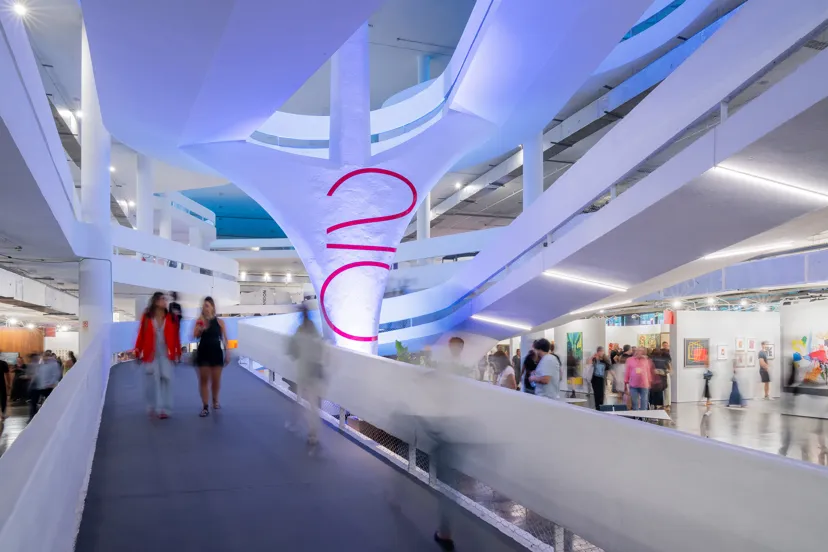
SP-Arte 2024
The 20th anniversary edition of SP–Arte, which took place from April 3 to 7, gathered over 190 exhibitors at the Bienal Pavilion, including national and international art galleries, design studios, publishers, cultural institutions, and independent spaces. With a successful turnout and results that exceeded many exhibitors’ expectations, the fair solidified its position as the event that kicks off the country’s art market calendar and as the largest art and design fair in the Southern Hemisphere, aligning it with the world’s major fairs.
With tickets sold out on the third day of the fair, the event welcomed 32,000 visitors and has already set the dates for the 2025 edition: from April 2 to 6, at the Bienal Pavilion. But before that, later this year, the third edition of Rotas Brasileiras will take place from August 28 to September 1, at ARCA. The fair will feature projects specially curated for the occasion by galleries from across the country and celebrates the diversity and richness of Brazilian art. This year’s edition of Rotas Brasileiras will be under the artistic direction of curator Rodrigo Moura, current chief curator at Museo del Barrio in NY, with past tenures at MASP and Inhotim, among other institutions.
SP–Arte brought together collectors, curators, artists, designers, architects, students, and the general public interested in art and design, reaffirming its relevance and reputation on the national scene. Positive aspects highlighted by the exhibitors themselves include the high level of works presented at the event and the qualified profile of buyers, many of whom are well-informed, young, and interested in purchasing art and design.
Highlights
The diversity of artistic languages and the high quality of the works displayed in the Art sector impressed both the specialized audience and those curious about art.
On the first floor, there were real rarities from modern artists such as Di Cavalcanti (Pinakotheke), Victor Brecheret (Paulo Kuczynski), and Ismael Nery (Fólio), along with pioneers like Judith Lauand (Berenice Arvani), Tereza D’Amico (MaPa), and Ione Saldanha. Notably, there were international artists such as the Italian Lucio Fontana and the Mexican Gabriel Orozco (Almeida & Dale).
Among the contemporary galleries on the second floor, established artists were present, such as Anna Maria Maiolino (Luisa Strina), Sérgio Camargo, José Resende (Marcelo Guarnieri), Adriana Varejão, and Artur Barrio (Central) – the latter two also participated in Talks at the fair. Among other generations, standouts included Ana Elisa Egreja (Leme), J. Cunha (Paulo Darzé), Vivian Caccuri (Millan), Thiago Martins de Melo (Lima), Yuli Yamagata (FDAG), Eduardo Berliner (Casa Triângulo) – nominated for the ArtNexus prize – and the indigenous collective MAHKU (Carmo Johnson Projects). International star artists such as the Argentine Marta Minujín (Herlitzka & Co.) and the American Lynda Benglis (Mendes Wood DM) drew public attention.
Young artists also gained prominence at the fair, including Froiid (Albuquerque Contemporânea), Diambe (Simões de Assis), Gustavo Diógenes (Leonardo Leal), and Tadáskía (FDAG). Among the institutions, notable works included Yael Bartana (Casa do Povo) – representative of the German Pavilion at the Venice Biennale, an unprecedented multiple by Paulo Nazareth (Pivô), and watercolors by Marina Rheingantz (Solar dos Abacaxis).
The Design sector had five vibrant days, with 67 exhibitors including 18 newcomers, divided between modern and contemporary, rare furniture, and unpublished collections, and an exhibition on the diversity of materials in current design.
International design made its mark in secondary market galleries. Apartamento 61 brought a large 1950s George Nelson shelving unit with custom-designed Tapio Wirkkala lamps, along with the modular DS600 sofa from 1972, featuring space-age influences reflected in the silver walls of the stand. Teo showcased an exhibition from Forma, a company that licensed classics from Knoll International in Brazil, like the Warren Platner set. At Artemobilia, the trajectory of the Hauner brothers and Martin Eisler from Móveis Artesanal to Forma was highlighted, featuring several chairs with their signature slender metal frames. The AMDMB, an association that brings together galleries specializing in Brazilian modern vintage, recreated the hall of the iconic Lausanne building, with a selection of rare Branco&Preto furniture. At Passado Composto, more rarities in jacaranda by Joaquim Tenreiro, Geraldo de Barros, and Jorge Zalszupin were featured.
Novidário also provided collectors for PET bottle caps consumed during the fair at the pavilion, to manufacture furniture that will be launched and exhibited in 2025 at the event; the raw material was also used in the brand’s showcased launches in the Trilha Lines, Mapa Rugs, and Pipa Chair.
Sales
The commercial success of the fair was confirmed by various gallery owners. Thais Darzé, director of Paulo Darzé Galeria from Salvador, said: “The fair was positive in all respects, we closed fifteen deals. We were happy to spread the word about the artist J. Cunha, who is still little known to the general public. The most positive aspect is that 60% of the deals were with new clients. This is a sensational response as it builds new generations of collectors, new markets.”
Ulisses Cohn, one of the leading names at DAN Galeria, states that the 20th edition was exceptionally good. “We sold artists at various price levels, ages, and styles, it was a fair that resulted in a very broad positive outcome for us.”
André Millan, from Millan, stated: “We noticed a 70% growth in sales compared to the previous edition. It is interesting to note that we sold works from both established artists and young talents at the beginning of their careers. This indicates that the audience and collectors at the fair now have a more diversified profile than in previous editions. Overall, the fair was very good.” One of the works sold was the installation “Blue Tango” by Miguel Rio Branco, consisting of 16 pieces and created 20 years ago.
Gomide&Co also celebrated success. The gallery sold a total of 35 works. According to co-founder Thiago Gomide, this year’s fair was very positive. The gallery sold a work by Lorenzato for R$ 1 million; one by Chico da Silva, valued at R$ 150,000; another by the artist Lenora de Barros, for R$ 120,000, in addition to works by Julia Isidrez, Nilda Neves, and Maria Lira Marques, for R$ 20,000, R$ 60,000, and R$ 80,000, respectively.
Isadora Ganem, director at Mendes Wood DM, stated she was very pleased with the edition and the results. She commented that they managed to position the artists very well, especially those who will participate in the Brazilian pavilion at this year’s Venice Biennale, with emphasis on Lucas Sithole and Sonia Gomes. For Antonia Bergamin, from Galatea, the fair was great. By Saturday (6), the gallery owner reported having sold around 18 works, noted that some others were being negotiated, and likely sales would consolidate post-fair.
Among primary market gallery owners, the mood of satisfaction was also evident. Carmo Johnson, from Carmo Johnsons Projects, affirms having sold works by the Collective Mahku, which will be featured in this year’s Venice Biennale. According to the gallery owner: “It was the best fair. We believe it fulfilled 100% of its role, which for us is to sell and make good deals.”
Lucas Cimino, from Zipper Galeria, believes that, increasingly, fairs are expected to fulfill institutional roles. “Obviously everyone hopes to sell and we did sell well, but I believe that presence at the fair is a very important showcase, and it contributes to gallery visitation throughout the year.” The gallery sold 29 works and bets on the post-fair. Among them, large-scale works, like one by Janaina Mello Landini from the “Ciclotrama” series, measuring 2m x 4m. In addition to various works by the artist Flávia Junqueira; about four by the artist Laura Villarosa (one measuring 50cm x 2m), and works by Daniel Mullen. According to the gallery owner, in terms of the number of sales, this year’s edition was superior to the previous one.
Among the exhibitors from outside the Rio x São Paulo axis, Marco Zero, from Recife, also noted a heated edition. According to Amanda Alencar, executive producer of the gallery, the fair was great and better than in 2023. “The edition was a good way to initiate contacts and present works by artists we are representing. We brought a project focused on artists from Paraíba and Pernambuco, curated by Jacopo Crivelli Visconti. Being present at the fair is always very positive for relationships.”
For Marco Antônio Lima, from the Maranhão gallery Lima, the fair was very good from an institutional point of view. “We had a very large repercussion among curators, institutions, and collectors, with our artists positioning themselves well in the market.” Regarding sales, the gallery owner comments that they made good deals and were happy with the results.
Among international gallery owners, Mariano Ugalde, director of Salar Galería de Arte (newcomer to the fair), stated: “For us, the 20th edition was a success. Commercially, we succeeded with coverage from the specialized press, with the presence of collectors and an audience specialized in contemporary art. We were able to show a bit more of what we do, our programming, so it was undoubtedly a success and we hope to return next year.”
20 Years of SP–Arte
The atmosphere is one of celebration and joy for Fernanda Feitosa, founder and director of SP–Arte. “We are extremely satisfied with this milestone edition, which celebrates 20 years of intense, rigorous, and collectively built work by the fair alongside galleries, artists, designers, and arts supporters. The very high quality of the works presented by the art and design galleries places SP–Arte on par with the most important fairs in the world.
I am proud and grateful to everyone who makes the fair happen, starting with my extraordinary teams in architecture, design, communications, production, curation, technology, photography, and video, for having realized a historic edition, with successful media reach, both nationally and internationally. Long live SP–Arte, and here’s to the next 20 years,” she declared.
One of the major challenges of the event is the logistics of accessing Ibirapuera Park. While not solely the responsibility of the fair’s organizers, SP–Arte always seeks to work with authorities and the park to improve the situation. The road access and parking infrastructure in and around the park are deficient. It is clear that the available infrastructure cannot support the flow of vehicles and visitors during major events like SP–Arte, the São Paulo Biennial, and, for example, the recent G20.
Another challenge of the fair is the taxation issue on the commercialization of artworks, particularly the ICMS and the import tax. Recognized worldwide as cultural goods, artworks are subject to taxes that range from 0 to 7%, whose free movement should be promoted. In Brazil, the ICMS is 18% and the total tax burden on imports reaches 58%. The high cost affects both the importation of works by foreign artists from abroad and the repatriation of works by our artists. The organization of SP–Arte believes that the country loses out by not having this circulation. The exemption of ICMS for works sold at the fair, which had been in effect since 2012 and was suspended this year, allowed Brazil to engage more equally in the global art market, representing a gain for the public who have access to relevant international works, the Brazilian art market, and, consequently, the country.
The cultural exchange that occurs, resulting from international presence, is fundamental to the cultural richness and public education in the country. By not having the benefit of the exemption, the public loses out, who will no longer see these works in the country, and the consumer who will pay more. The country loses, culturally isolating itself. The exemption is a public policy tax tool aimed at promoting a fragile sector like the visual arts, yet vital for the creative economy, and with undeniable impact on public education and formation.
Programming
This year again, SP–Arte offered visitors an immersion into the artistic universe through its public programs. The Talks program, held in partnership with Iguatemi, brought together artists Vik Muniz, Paula Siebra, André Namitala, Gervane de Paula, Adriana Varejão, Vinicius Gerheim, Igi Lola Ayedun, Lidia Lisbôa, and Tiago Sant’Ana in discussions with Catarina Duncan, Fernanda Brenner, Maria Prata, and Carollina Lauriano.
As in the previous edition, audioguides continue to be a highlight in 2024: there were about 1,000 listenings during the week of the event, nearly double last year’s figure. For the 20th SP–Arte, the thematic scripts were formulated and narrated by Victor Gorgulho, Thais Rivitti, Renata Felinto, Giancarlo Hannud, and Felipe Molitor.
Circuito SP–Arte
The Circuito SP–Arte programming kicked off with the opening of the exhibition “Funil”, curated by Isay Weinfeld and Lucas Jimeno at Casa SP–Arte. It featured various activities promoted by art and design galleries: openings, guided tours, and open studios, totaling more than 60 events throughout the city, enlivening neighborhoods such as Higienópolis, Vila Madalena, Pinheiros, Barra Funda, and Jardins.
Donations
Every year during SP–Arte, artworks are donated to the collections of important museums. Right on the first day, galleries highlighted the artworks donated to the Pinacoteca do Estado de São Paulo through labels on their stands. These include:
– “Makunaima conversa com o espírito do caxiri nos pés de batata-doce,” by Gustavo Caboco, represented by Millan.
– “Ñamirĩ Bʉkhʉ Mahsʉ̃ Pahti kʉ̃,” by Buu Kennedy, represented by Luiz Maluf Gallery.
– A work from the “Couro Laminado” series by Gê Viana, represented by Superfície.
– “Casa em Amarelu” (from the series “Quadrus Negrus”), by Marga Ledora, represented by Janaína Torres Gallery.
In addition, a cruciform oratory presented by Sandra & Márcio Gallery at the fair was donated to the Museum of the Oratory.
Sponsorship
SP–Arte establishes a strong partnership with its sponsors, with whom it shares the goal of developing an international platform to foster the exchange of ideas that influence the global art scene. The event is sponsored by Itaú, Vivo, Iguatemi, and Vivara as master sponsors, and sponsored by Kinea, Rede, BMW, Chandon, Unipar, Blue Moon, Trisoft, and Finarte.