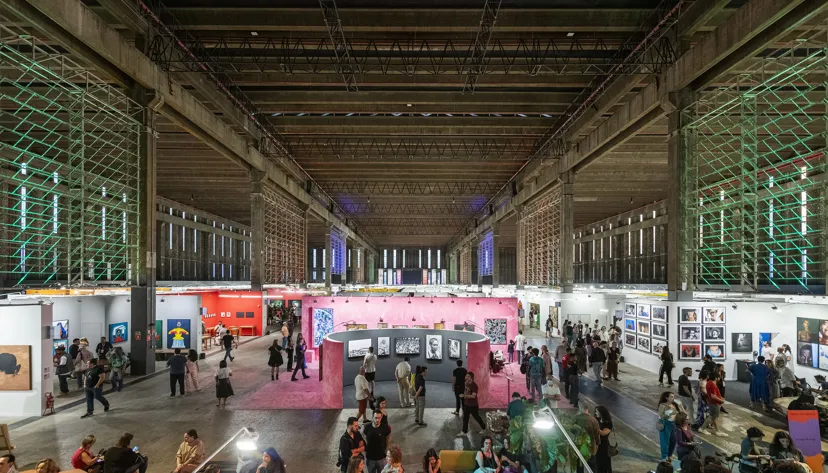
Rotas 2022
The first edition of SP–Arte Rotas Brasileiras concluded with artists and exhibitors coming together in celebration after five days of immersion in Brazil's richness, plurality, and diversity, along with a shared desire to continue opening new routes and possibilities.
From August 24 to 28, 2022, the new SP–Arte fair took place at ARCA in Vila Leopoldina, featuring 70 exhibitors, including galleries and invited projects that broaden perspectives on Brazil.
Focusing on curated projects, whether solo or collective, the fair aimed to strengthen connections among participants from all five regions of the country, highlighting photographic and artistic production across the entire nation.
Seventy exhibitors participated, comprising art galleries and invited projects that interwove different perspectives of Brazil. For this edition, SP–Arte prioritized bringing exhibitors from various states who are interested in addressing diverse Brazilian artistic practices, breaking down boundaries between the scholarly and the popular, the central and the peripheral, the commercial and the institutional, and showcasing the worldviews of Brazil’s many identities.
With this new edition, the fair solidified its role as a catalyst for the national visual arts market and a driver of the city’s creative economy. SP–Arte, along with galleries and other partners, offered an exclusive program.
According to Fernanda Feitosa, the founder and director of the fair, “The galleries embraced the challenge of creating a fair with a thematic axis, resulting in very powerful booths and an enchanted audience.” She also confirmed plans to repeat the experience next year: “The warm reception and success of the fair motivate us to continue this journey to discover new artists and explore other destinations within Brazil in August 2023.”
Exhibition "Brasilidade Tradicional"
At Rotas Brasileiras, curator Ana Carolina Ralston presented a show titled Brasilidade Tridimensional, featuring works by pivotal artists in the tradition of Brazilian sculpture, such as Francisco Brennand, Marepe, and Tomie Ohtake, displayed in the outdoor area of ARCA.
In the curator's words, “The sculptures, whether close to the ground or reaching for the sky, weave the visitors' path through this edition of SP–Arte, with the clear intent of reminding us that art resides inside and outside of everything and everyone.”
Participating artists included Amorí (HOA), Antonio Bokel (AM Galeria), Carmela Gross (Vermelho), Francisco Brennand (Gomide&Co), José Spaniol (DAN), Lucas Dupin (Lume), Marepe (Luisa Strina), Mario Cravo Júnior (Pinakotheke), Rizza (Zipper), Rodrigo Bueno (Marilia Razuk), Rodrigo Sassi (Central), Tomie Ohtake (Nara Roesler), Túlio Pinto (Millan), and Verena Smit (Karla Osorio).
Editorial Launches
On August 24, the HOA stand, in collaboration with Almeida & Dale, hosted the launch of “Sidney Amaral: Manifesto de Cognição y Memória”. Combining a chronobiography, Amaral’s résumé, and critical texts, the book—conceptualized by the two galleries together with the content hub MJournal—features essays and works by artists Almeida da Silva, George Teles, Mayara Velozo, Marlon Amaro, M0xc4, and Rafaela Kennedy.
On August 25, artist Alexandre Furcolin, represented by Galeria Karla Osorio, launched the book “São Paulo” from the Fashion Eye collection, published by Louis Vuitton. During the Rotas Brasileiras event, Furcolin signed copies at the gallery’s stand. He is the only Latin American artist selected for this prestigious collection by the French brand, offering new perspectives of the city through a contemporary and transgressive lens.
On August 27, photographer Gabriel Wickbold launched his book “Brasileiros” at his stand during the fair. The book captures a journey from the source to the mouth of the São Francisco River, with a preface by Emicida and a prologue by Rubens Fernandes.
Art and Technology
Parallel to Rotas Brasileiras, the second edition of Pupila Dilatada, a psychedelic crypto-art exhibition, was held at the STATE building, located next to ARCA. With free admission, the show featured the participation of over 60 Brazilian and international digital artists. The event's opening night included live performances by five pairs of VJs and experimental musicians, who mapped the exhibition in real time, creating an immersive audiovisual experience.
On August 25, two discussions from Pupila Dilatada were integrated into the Rotas Brasileiras program. At 4 PM, Olivia Merquior invited Giovanna Casimiro, Cultural Head of Decentraland, for a debate on virtual environments, deterritorialization, and universal culture. At 5 PM, the impact of new technologies on the creative processes of Brazilian artists was the theme of a conversation between Mariana Falcão (Mari The Hawk), Pedro Brasil (sonnigraphics), and Paulo Stocker, moderated by Olivia Merquior.
Conversations on the Bleachers
Amid the dynamic atmosphere of the event, the Conversas na arquibancada program created opportunities for the audience to engage with prominent names in Brazilian art. With a dynamic format, different artistic practices were presented through the voices and presence of the artists themselves.
The conversations took place at the STATE building, adjacent to ARCA, and revolved around creative processes, behind-the-scenes insights into major projects, and audience questions. The discussions were moderated by Leandro Muniz, who facilitated exchanges that provided deeper understandings of artistic practices and projects.
Audio Guides
For the third consecutive edition, SP–Arte offered audio guides that explored the works and artists featured in the fair, providing an immersive experience for diverse audiences. For this edition, the thematic scripts were developed and narrated by curators Henrique Menezes, Ariana Nuala, and Ludimilla Fonseca, offering a variety of starting points for learning about and reflecting on Brazilian art.
The proposed themes included perspectives on the importance of festivals and street manifestations, the influence of natural phenomena on artistic creation, and the transformation of everyday objects into art. The curators also revisited the concept of tropicality, introducing an “aesthetic of cold” to reflect on precariousness as a historical issue and the dichotomy between truth and performance in photography.
Master sponsor Vivo presented an exclusive audio guide dedicated to Brazilian Indigenous art, developed by educator Djeguaka Xondaro. This guide reflected on how the works of artists like Jaider Esbell and Gustavo Caboco contribute to transforming reality. All audio guide scripts are available on SP–Arte’s Spotify channel.