By Ana Carolina Ralston
Hello, I’m Ana Carolina Ralston, a curator and researcher in visual arts. Today, I’ll be with you for a tour of SP-Arte 2026. To guide us, I’ve prepared an audio guide featuring my main highlights, following one of the central themes of my curatorial research: nature and its connections with technology and ancestry.
To begin our journey, I invite you to slow your gaze and notice something that often goes unnoticed: the way nature, technology, and ancestry do not exist as separate fields, but as deeply intertwined dimensions of contemporary life.
For a long time, we learned to think of nature as something “outside”—distant, opposed to the human, and far removed from technology. However, contemporary thinkers and botanists such as Stefano Mancuso have demonstrated what we already sensed: that plants are highly sophisticated organisms, capable of perceiving, reacting, communicating, and even making decisions—albeit through means radically different from our own. In this sense, intelligence ceases to be an exclusively human trait and becomes understood as a property distributed throughout life itself.
It is from this perspective that the works selected for this audio guide can be viewed—not as representations of a distant nature, but as expressions of a world in constant relation. A world in which the technological is also natural, in which the ancestral persists within the contemporary, and in which every form of life carries multiple temporalities.
In the work of Renata Haar, presented by Galeria Hollander Pappi on the second floor (booth G11), the presence of a large marble stone shifts the notion of sculpture as a static form and brings it closer to a deeper temporal experience. Marble, a material formed over millions of years, carries within it a geological memory that far predates the human scale. By bringing it into the space of the fair, the artist does not simply present an object but activates a direct relationship with this expanded, almost inaccessible time.
At the same time, there is a subtle tension between nature and intervention: although the stone asserts itself as a raw, ancestral element, its insertion into the context of art transforms it into an image, into a surface for reading—almost like an interface between different layers of existence. In this encounter, the work invites us to perceive matter not as inert, but as a bearer of history, energy, and continuous transformation.
At the booth of Galeria Luciana Brito, also on the second floor (space F3), Mexican artist Bosco Sodi presents works that emphasize his meticulous engagement with materiality—earth, pigment, and natural fibers. This relationship with materiality extends beyond the studio: through Casa Wabi, a project he founded in Mexico, Sodi created a residency program that invites artists from around the world to develop research in direct dialogue with landscape, time, and local communities. In this way, his practice expands beyond the object, affirming art as a shared experience and as a space of encounter between nature, culture, and contemplation.
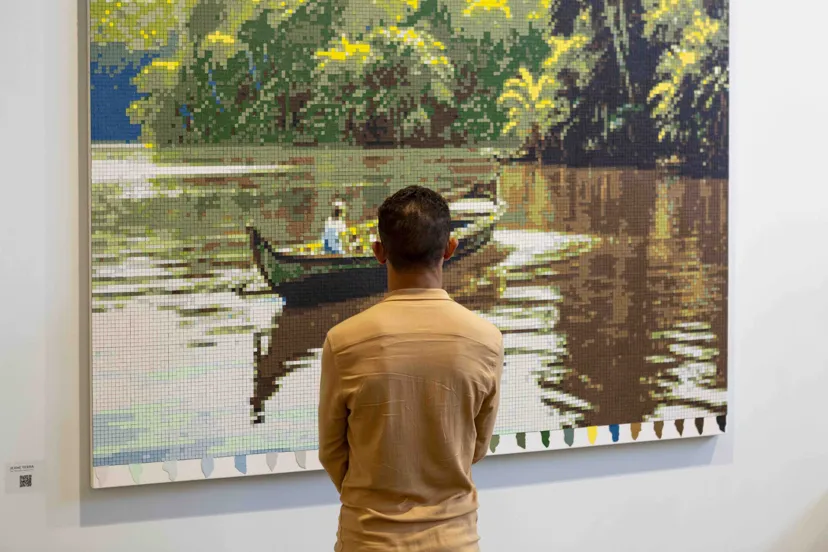
Ancestry and the history of the colonization of the Americas are central themes in the work of Peruvian artist Sandra Gamarra, featured at Galeria Leme on the second floor (space D7). Currently presenting a powerful exhibition at MASP, Gamarra is the founder of the fictional museum LIMAC, which highlights asymmetries between center and periphery, original and copy, memory and erasure. Her work not only revisits the past but critically reinscribes it in the present, inviting viewers to recognize that every image is also a political device, shaped by disputes over power, identity, and belonging.
Radicality is also present in the work of Kishio Suga, shown at Galeria Mendes Wood DM on the second floor (space E7). A member of the Mono-ha movement that emerged in Japan in the late 1960s, Suga works with materials in an almost raw state—stone, wood, metal, rope—arranging them in minimal configurations that do not seek to transform them but to reveal their conditions of presence.
Political and social reflections related to nature permeate the fair and can be found at Galeria Marilia Razuk, on the second floor (space G8). The ceramic series “Mercado de Águas” investigates the mercantile and territorial dimensions surrounding the circulation of water and natural resources—an important and recurring theme in the artist’s work.
Activism also permeates the work of other artists, such as Frans Krajcberg and Jaider Esbell, both exhibited at Galeria Gomide on the second floor (space A2). By working with charred trunks and remnants of burned forests, Krajcberg transforms devastation into a sensitive form of protest, turning wounded matter into a cry against environmental violence. Esbell, drawing on Indigenous cosmologies—particularly those of the Makuxi people—re-enchants the world by affirming the forest as a living territory, shaped by spirits, narratives, and ancestral knowledge that resist extractivist logic.
Between them, an ethical continuity emerges: both mobilize art as a form of insurgency, proposing not only contemplation but also awareness of ecological urgencies and the need to reimagine our ways of coexisting with the Earth.
Coexistence is also a central theme in the work of Ayrson Heráclito, featured at Galeria Darzé on the first floor (space C2). His work articulates matter, body, and spirituality in a practice deeply rooted in Afro-Brazilian cosmologies, especially the knowledge systems of Candomblé. Using elements such as palm oil, salt, meat, and iron, the artist creates actions and installations that evoke rituals of healing, memory, and transformation, where the artistic gesture approaches an act of historical restitution.
His production, marked by a strong sensory and symbolic dimension, reinscribes narratives shaped by the African diaspora into the present, challenging erasures and reactivating ancestral ties. In 2026, by participating in the Venice Biennale, Heráclito reaffirms the power of Brazilian art as a critical force on the international stage—bringing with it not only a singular poetics but also a political stance that calls for alternative ways of existence, memory, and belonging.
We’ve reached the end of our audio guide!
I hope you’ve enjoyed it and that you make the most of your visit to this edition of SP-Arte!