Welcome to SP Arte 2025. My name is Theo Monteiro, and I am a curator and professor of art history, specializing in Brazilian and Latin American art history. Now, I will introduce you to some historical artists featured at the fair.
SP Arte is primarily focused on contemporary art, but we can also find some older, historical artists and well-established works here. These pieces are essential for understanding, through a contemporary lens, the trajectory of art—where it is heading, which references today's artists are looking at, and even some of the current market trends.
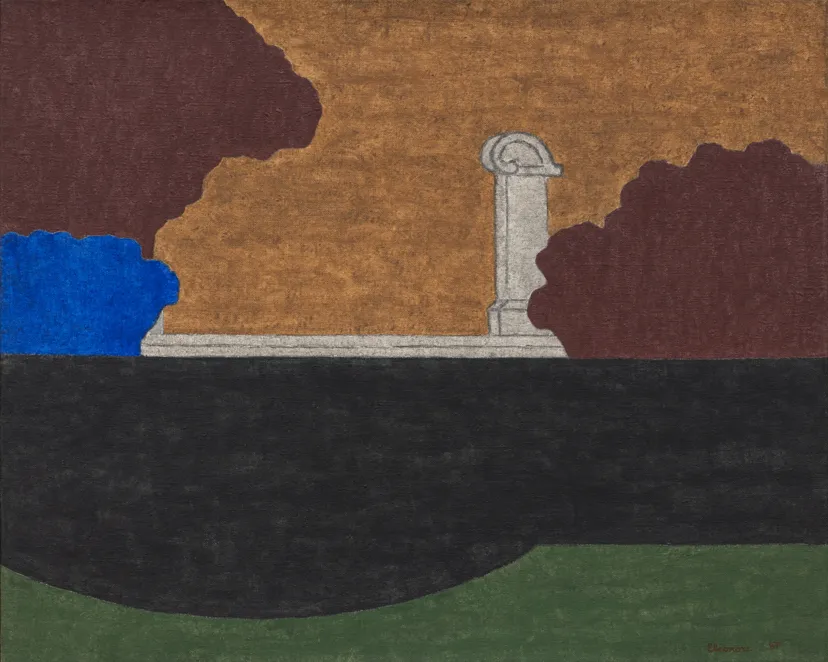
I'll start with Almeida & Dale Gallery, which presents a strong selection of historical artists, and I would like to highlight two in particular. One of them is Eleonore Koch. She produced work throughout the 1960s, 1970s, and 1980s, and it is fascinating that she was one of the few disciples of Alfredo Volpi.
We can observe some similarities between their works, especially in Koch's use of pictorial material—she painted with tempera. Unlike oil paint, which uses linseed oil as a binder, tempera uses egg yolk and white, resulting in a thinner medium that dries quickly but offers more vibrant and luminous colors. Unlike Volpi, Koch did not focus as much on popular Brazilian themes, such as colonial houses and flags. Instead, her approach was different.
Her work features familiar everyday objects—chairs, vases, flowers, and still lifes—yet they are arranged in expansive, luminous color fields, creating a profound atmosphere of silence. These compositions contain only a few elements, sometimes mere traces of landscapes, with nearly pure colors generating a contemplative, immersive experience.
Another significant artist, not only for contemporary Brazilian art but also internationally, is Rubem Valentim. He was a geometric abstractionist from Bahia whose artistic development flourished in the 1950s, a crucial period for Brazilian art history. During this time, Brazil was experiencing its industrial revolution, modernism was reaching its peak, and geometric abstraction was gaining traction in artistic debates.
While Rubem Valentim engaged with Brazil’s geometric abstraction movement, he was also deeply connected to Bahian modernism. In Salvador and the Recôncavo Baiano, this movement embraced cultural and religious elements intrinsic to Bahia. In literature, for example, we see Jorge Amado capturing the magical and mythological aspects of Afro-Brazilian religions, Bahian cuisine, and the Pelourinho district, which remains central to Bahia’s cultural identity.
Valentim incorporated these Afro-Brazilian religious elements into his geometric abstraction, developing a unique artistic language. He synthesized spiritual and philosophical symbols—such as Xangô’s hammer, Exu’s trident, and Oxalá’s staff—into pure geometric forms that interact symmetrically within his compositions. His work reflects the interconnected worldview present in Afro-Brazilian traditions, where everything is interwoven. The broad areas of vibrant, pure color lend his paintings a graphic quality while emphasizing their spiritual dimension. Valentim was among the first to bring Afro-Brazilian spirituality into Brazilian geometric abstraction and constructive art.
Now, shifting to Galeria Flexa, I want to highlight two remarkable artists. The first is Adriana Varejão. Although she remains an active figure in contemporary art, she holds historical significance due to her emergence in the 1980s, a decade marked by a global resurgence of painting.
In the 1960s and 1970s, new artistic languages—such as video art, performance, installation, and happenings—emerged, pushing painting aside. However, in the 1980s, painting made a strong comeback, producing internationally renowned figures like Basquiat, Keith Haring, and Anselm Kiefer.
In Brazil, Adriana Varejão played a key role in this revival. However, she and her contemporaries did not simply return to traditional painting; rather, they incorporated the innovations of previous decades. These artists explored new materials and techniques, treating painting as a surface—an idea central to Varejão’s work.
Her paintings often mimic other surfaces, resembling tiles, carcasses, tattooed skin, and church panels. While she draws on Brazil’s historical imagery, she does not limit herself to it. Her work poetically imitates various textures and materials, always reminding us that, despite the illusion, what we are looking at remains a painting.
Another crucial figure in both Brazilian and international art is Lygia Clark. Like Rubem Valentim, she was a geometric abstractionist, but her approach was distinct. Producing art in Rio de Janeiro in the 1950s, she developed a geometry that was not purely mathematical or formalist—it also incorporated elements from everyday life.
A striking example is her "Bichos" (Creatures) series. Although Clark used industrial materials and precise geometric shapes, her sculptures referenced organic structures. The "Bichos" have skeletal frameworks that allow controlled movement, similar to how real animals have a defined range of motion. When Clark created these works in the 1960s, the idea was for the public to manipulate them, making interaction an integral part of the artwork.
This participatory element was groundbreaking and paved the way for interactive works in contemporary art. However, today these pieces can no longer be handled, as they have become historical artifacts—rare works that encapsulate a pivotal moment in both Brazilian and global art history. Lygia Clark was a pioneer in expanding the boundaries of geometric abstraction, bridging art and audience participation.
Finally, I turn to Galeria Gomide, which presents an important Paraguayan artist, Julia Isidrez. Although she is still active today, Isidrez is a key figure in Paraguayan art. Paraguay is deeply influenced by Indigenous cultures, with Guarani as its second official language alongside Spanish. Indigenous traditions are strongly embedded in daily life and artistic practices.
Isidrez herself is of Guarani heritage, and this is evident in her work, which is crafted from fired clay. The Guarani people, in both Paraguay and Brazil, have a long tradition of ceramic sculpture, and Isidrez learned the technique from her mother, who in turn learned it from her grandmother.
Paraguayan art has a strong Indigenous foundation, exemplified by the renowned Museo del Barro in Asunción, which houses centuries-old ceramic works. In contemporary times, Isidrez continues this legacy.
She primarily creates sculptures in the form of plates and vessels, but these objects often take on the appearance of living beings—animals, human figures, and hybrid creatures. We see mouths, paws, tails, and other zoomorphic features emerging from everyday objects.
At first glance, these pieces might seem like simple functional items, but upon closer inspection, they reveal connections to mythology, spirituality, and a worldview that emphasizes harmony with nature. Through her work, Isidrez preserves and reinterprets Guarani artistic traditions, bringing them into the contemporary art world.
These artists, each in their own way, remind us that historical art is not merely a thing of the past—it is a living presence, constantly informing and shaping contemporary artistic practices.

Lozenzato, Untitled, exhibited at the Paulo Darzé gallery booth. Photo: courtesy.
Julia Isidrez is an artist who has been gaining more and more recognition in Brazil. Many collectors and curators have shown interest in her work, and proof of this is her inclusion in the 2024 Venice Biennale. Her work was featured precisely because it represents a fraction of a culture that is of great importance—one that Julia Isidrez learned from her mother and grandmother and continues to practice, keeping this tradition alive and relevant.
The Paulo Darzé Gallery from Salvador is also showcasing an artist who has been gaining significant recognition in recent years—an already deceased artist, the Minas Gerais-born Amadeu Luciano Lorenzato, or simply Lorenzato, as he is best known. Lorenzato was a key figure in Belo Horizonte throughout the 1960s, 1970s, 1980s, and 1990s, but until very recently, he was practically unknown in the rest of Brazil.
Now, his name is being rediscovered with great momentum—both through the art market and gallery exhibitions, as well as major institutional and curatorial shows. A book about him was recently published. Fortunately, though posthumously, his work is finally receiving the attention it deserves from both the market and institutions.
Originally a construction worker, Lorenzato painted on weekends. After suffering a work accident, he retired and dedicated himself almost exclusively to painting. It is fascinating to see how his experience in construction was fundamental to the development of his artistic practice.
When we look at his paintings, the first thing we notice is their slightly rough texture, reminiscent of frescoes or walls. Their consistency is similar to that of architectural surfaces, and this is no coincidence. The paint he used was made from mineral pigments—often the same ones used in construction.
Another material he employed was a type of comb, which he used to scrape his paintings. He had done something similar in construction when stripping plaster from walls. In his paintings, this technique created undulating, subtly wavy textures that emphasized the roughness of his surfaces.
His pigments and colors often lean toward earthy tones. Even when he works with greens or blues, there is always a mineral, fresco-like presence. He was also a master of volume, constructing cityscapes with remarkable geometric precision. At times, we can even sense the influence of early Italian Renaissance artists.
This is not accidental—Lorenzato lived in Italy for a time and was exposed to the works of some of these masters. But rather than simply adopting their references, he brought them into the materiality of the Brazilian city—the ever-changing, growing urban landscape, a world he knew firsthand as a construction worker. His painting technique and material choices reflect this deep connection to his surroundings.
Another significant gallery, Galeria Frente, is showcasing works by Antônio Dias from the late 1960s and early 1970s—a particularly complex period in Brazilian history and in the artist’s own life. Antônio Dias began his career in Rio de Janeiro in the 1960s.
Initially influenced by New Figuration, his work incorporated elements of Pop Art. However, in the late 1960s, he left Brazil, moving between Italy and France, winning awards, and spending nearly a decade abroad. His departure coincided with the radicalization of Brazil’s military regime, especially after the AI-5 decree. Many others also went into exile at this time.
Antônio Dias did not return to Brazil. His works from this period shift away from Pop aesthetics, featuring deep black backgrounds with a pronounced graphic quality. They resemble maps or architectural plans, as if they were blueprints for imaginary spaces.
Curiously, despite their project-like appearance, these works evoke boundless spaces—vast, immeasurable, and undefined. They convey a sense of solitude, displacement, and the absence of a fixed place. Many of his pieces from this time address themes of placelessness and statelessness.
He engaged deeply with ideas of cartography, nationhood, and territory. Yet, rather than defining concrete spaces, his works suggest a world without precise boundaries. This coincides with the rise of conceptual art, not just in Brazil but globally.
Conceptual art, which gained momentum in the 1960s worldwide and in the 1970s in Brazil, treated art as a language. Artists used words, symbols, and ideas to construct meaning. Dias explored these themes intensely—territory, maps, national identity—framing them as conceptual investigations. His work from this period embodies this linguistic approach, marking a decisive shift toward conceptualism.
Another major São Paulo-based gallery, Galeria Paulo Kuczynski, which primarily focuses on the secondary market, is featuring works by several important artists, including a notable sculpture by Luiz Sacilotto.
Sacilotto was one of the key figures of geometric abstraction and Brazilian constructivism in the 1950s, particularly in São Paulo. His approach to geometry was highly precise, often carrying a sense of engineering.
This was a time of rapid industrialization in Brazil, especially in São Paulo. The geometric structures in Sacilotto’s work echo the aesthetics of modernist architecture—clean lines, pure forms, and striking colors. His compositions parallel the rationalist visual language of the time, which was evident in architecture, design, and painting.
Sacilotto’s significance lies in his contribution to the creation of a new visual language—one that reflected the shift from a rural to an urban, industrialized society. The modernizing country needed a fresh form of visual communication, and Sacilotto played a crucial role in this transformation.
His work focuses on the fundamental elements of visual composition: planes, lines, and colors. His paintings often have an industrial quality—he frequently used industrial paints, such as automotive enamel. This connection to industry is central to his practice.
Beyond being an artist, Sacilotto was also a factory worker in São Bernardo do Campo, his hometown, where a local pinacotheca now bears his name. His work merges industrial aesthetics with geometric abstraction, demonstrating a deep understanding of both material and form.
Much like São Paulo’s concrete poets—who explored the basic units of poetry, such as words—Sacilotto dissected the core components of painting and sculpture. His work distills geometry to its essence, creating compositions that are both rigorous and visually compelling.
Galeria Superfície, in turn, is showcasing an essential figure in Brazilian art of the 1960s, Rubens Gerchman—a historical artist whose influence extends far beyond Brazil.
Gerchman’s work immediately recalls American Pop Art. However, while there is a clear visual connection, the key distinction is that he did not focus on American mass culture but rather on the unique urban culture of Brazil.
Fascinated by the city, especially Rio de Janeiro, Gerchman depicted its rapid transformation during the 1960s. This was a time of intense urban migration and industrial expansion. Cities were growing explosively, reshaping social and cultural dynamics.
Gerchman captured this new urban reality. He incorporated elements of daily life—football, samba, vibrant street signs, the colorful façades of Rio’s favelas—into his paintings. His work bridges the everyday and the extraordinary, translating Brazil’s visual culture into a distinctive Pop aesthetic.
Rather than mimicking American Pop Art, he adapted its language to a Brazilian context, creating a body of work deeply rooted in local culture and visual identity.

Luiz Sacilotto, untitled, 1958. Photo: courtesy
And then, of course, he also provides an important testimony about what visual culture was like in the 1960s. When we look at his work, we remember some album covers, the fashion of that time, because it truly helps to consolidate a visual perception of what pop culture was in Brazil during that period.
Galeria Ipanema, a gallery in Rio de Janeiro primarily focused on the secondary market, presents one of the main masters of our modernism, of our modernist painting: Alfredo Volpi. Alfredo Volpi, who was born in Italy at the end of the 19th century, moved to São Paulo as a child and built his entire career there. Volpi was practically a self-taught artist—he learned to paint on his own, yet from a very early age, he demonstrated an absolutely remarkable visual culture.
From the late 1940s onward, Volpi became deeply interested in color, exploring it through luminous and expressive nuances. In the 1940s, to work more effectively with color, he abandoned oil paint and started painting with tempera. Tempera, as I mentioned earlier, is a type of paint that does not use linseed oil as a binder but rather egg yolk and egg white.
This results in a thinner paint, but one that allows for more luminous colors, making the brushstrokes more visible. All of this became essential for Volpi in his approach to geometric elements. As I mentioned, during the transition from the 1940s to the 1950s, Brazilian Constructivism emerged. Geometric abstract art took shape in Brazil, and Volpi developed a completely unique form of geometry. Not only did he reference geometric and visual games, but through geometry, he evoked Brazil’s colonial houses, vernacular architecture, small towns, cultural traditions, flags, religious festivals, processions, and little churches. He looked at a still pre-industrial Brazil, an artisanal, perhaps even semi-rural Brazil.
Thus, Volpi’s geometry is not one of strict lines and rulers but an artisanal, hand-crafted geometry, marked by its imperfections. His brushstrokes are always visible, and as he believed, colors are alive and vibrant. At certain moments, particularly at the turn of the 1950s to the 1960s, his colors darken somewhat, but they never lose their expressiveness. Shades of purple and black, for example, maintain a fascinating luminosity.
In the 1960s, he reintroduced yellow and lighter greens, shaping his unmistakable flags. These flags and their poles are remarkable. They encapsulate an element deeply rooted in Brazilian culture—our popular festivals—while also embodying something universal. The flag, while a part of our folk traditions, is also a purely geometric form.
Thus, Volpi seamlessly combines the universal language of geometry with Brazil’s distinctive culture and social customs. His painting also refers to an artisanal world, a handmade world, a silent world. His works, especially from the late 1940s onward, rarely depict people. Instead, his geometry and geometric forms seem to float in vast fields of color, evoking a quiet atmosphere that invites viewers to immerse themselves in his chromatic universe.
Meanwhile, Galeria Pinakotheke, another gallery focused on the secondary market, showcases two significant artists—one for international art, Joan Miró, and one for Brazilian art, Antônio Bandeira.
Joan Miró, a Catalan artist, began his career in the late 1910s and early 1920s, heavily influenced by Surrealism. His work features strange creatures—part human, part animal—and landscapes that morph into dreamlike visions. His vocabulary is oneiric and wildly imaginative. He also incorporated elements from medieval Catalan and Spanish culture into his work. This distinctive Surrealism, rich in color, eventually gave way to new experiments. Though he moved away from Surrealism, Miró remained highly experimental, pioneering the use of unconventional supports like cardboard and wooden scraps as canvases.
In doing so, he expanded the very concept of painting. Even as he distanced himself from Surrealism, his work retained a dreamlike quality. Recognizable symbols emerge in his paintings, but they are distilled to their essence. At times, his work flirts with abstraction, yet he never fully abandons figuration, instead occupying a space between the two.
Looking at Antônio Bandeira, the parallels become clear. Bandeira was an abstract artist, yet his work followed many of the same paths Miró had opened. Unlike geometric abstractionists, Bandeira’s brushwork was deeply lyrical. Occasionally, hints of geometry appear, but they dissolve into dynamic strokes, interplay of colors, and luminous effects.
He developed an entirely unique atmospheric abstraction, pioneering lyrical abstraction in Brazilian art. Others, such as Yolanda Mohalyi, Tomie Ohtake, and even Iberê Camargo—albeit in a distinct style—would also contribute to this movement. Bandeira’s work is one of Brazil’s most significant contributions to lyrical and expressive abstraction, a movement that gained traction in the United States through Abstract Expressionism. Yet Bandeira infused this artistic language with a singular Brazilian sensibility.
This concludes our exploration of some historical artists featured at SP-Arte 2025. It is essential to recognize that contemporary art does not emerge in isolation—it is always in dialogue with the past, with artworks created decades ago.
This dialogue unfolds on multiple levels: through technique, visual language, and artistic references. Contemporary artists look to historical works not only to learn how to paint or sculpt but also to understand which themes have been significant, which questions remain relevant, and which need to be revisited or reinterpreted.
It is this ongoing conversation between past and present that keeps art in constant renewal and reinvention.
SP-Arte provides an exceptional setting to witness this dialogue, where contemporary artists producing work today stand alongside historical artists who created decades ago.
It is in this intersection of past and present that we grasp how art remains a living language—one that continuously transforms, reinvents itself, and engages with its time.
That is why SP-Arte is such a vital event—it allows us to see art as a dynamic and evolving force.
I invite you to continue exploring SP-Arte 2025, discovering new artists, new works, and new stories. And to keep being captivated by the beauty and power of art.
Thank you.