por Isabela Galvão
Hello everyone, my name is Isabela Galvão and I’m the founder and director of London Art Walk. Our mission is to create meaningful experiences with art through bespoke tours of museums, galleries and cultural institutions in Brazil and the UK. Our guided visits balance rigour with accessibility, a good sense of fun, and a rounded understanding of the market forces that shape the art ecosystem. London Art Walk is also an art advisory. From confident collectors to people buying their first artwork, we tailor to the needs of our clients, working with a cross-section of budgets.
Today I’ll be taking you on a journey through SP Arte 2026, sharing some of my insights and impressions of this year’s edition. This audio guide has four chapters. In the opening part, I’ll be talking about the fair, contextualising it within its history and the current dynamics of the art market, both nationally and on a global scale. Then, in the second chapter, I’ll share some thoughts on what to look out for in the secondary market – from Brazilian modernist titans to pioneers of Latin American kinetic art. Our third chapter will be a deep dive into some of my top picks from the primary market, a vibrant mix of rising stars and contemporary heavyweights. To close our tour, I’ll discuss some of my favourite designers taking part in this year’s fair.
PART 1: SP Arte 2026 – A BRAZILIAN FAIR WITH A GLOBAL OUTLOOK
This year is the twenty second edition of the fair, which started in two thousand and five. Since its inception, it has grown into the most important and internationally minded fair in Brazil. I myself have been going to SP Arte for several years, and it has been fascinating to see its evolution, the way it has remained resilient and dealt with the ups and downs of the market.
One of my favourite parts of attending SP Arte is its stunning location. It is one of the best places, in my view, to see art. I’m talking of course, about the Pavilhao da Bienal, a sprawling complex located in the centre of Ibirapuera Park. The Pavilion was originally built in nineteen fifty-four by Brazil’s master architect Oscar Niemeyer. Since its inauguration, it has held several editions of SP Arte and the Sao Paulo Biennial. The building is a true masterpiece, a structure that seems to be floating in space, a stark contrast to the sometimes more rigid architecture of many buildings that host art. Wandering through the pavilion, you will feel a strong connection to the art and to the nature that surrounds you. So, this year, before you take a deep dive into the art on display, I encourage you to look around the pavilion, pay careful attention to its wide ramps, signature curves and the extensive use of glass, which you can peer out from into nature.
This year’s SP Arte reinforces the fair’s reach and international outlook, presenting 104 galleries, 16 of which are international ones. But despite some incredible international galleries, participants remain, in the majority, Brazilians. This could be attributed to the ripple effects of the pandemic, to Brazil’s complex and bureaucratic customs system, and extremely high import taxes. Outside Brazil, in traditional centres such as New York and London, many galleries are struggling in a volatile economic climate. The Art Basel UBS 2026 Market Report from Dr Clare McAndrew shows we are in a high-cost environment with rising taxes in the US, rises in travel, hospitality, packing and shipping. Oil prices have been soaring since the start of the war in Iran. As a result, galleries are selling more in their regions than across borders. While this is not a sustainable model in the long term, it shows how the market can adapt to crises.
In Brazil, the scenario is rosier, as the market continues to boom and the atmosphere remains optimistic. The same Art Basel UBS Report shows Brazil as a growing economy, with 21% of growth, while the global market grew only 4% last year.
Despite the difficulties that come with this approach, it is still admirable to see a fair reaffirm its commitment to an international mindset. The art market is driven by confidence, and I know that SP Arte masters in client engagement and brings excitement to collectors.
PART 2: HIGHLIGHTS FROM THE SECONDARY MARKET
Now, let’s take a deep dive into some of my picks for this year’s artists to look out for in the secondary market. SP Arte 2026 features a fantastic selection of giants of Brazilian Modernism. To start off, I’d like to spotlight two names in particular that many of you will be familiar with: Tarsila do Amaral and Di Cavalcanti. Both are on display at gallery Almeida e Dale, on booth A1 on the first floor.
Tarsila do Amaral is one of Brazil’s leading historic painters. Born in eighteen eight six into a wealthy family, she developed a uniquely Brazilian style that used elements of the European vanguard. She was a key attraction of the show Brasil! Brasil! The Birth of Modernism at the Royal Academy of Arts in London in twenty twenty-five. She was also the subject of a major retrospective at the Museum of Luxembourg in Paris in the same year. At this year’s fair, visitors will be treated to her magnificent painting A Feira Dois, from nineteen twenty-five. The title translates to marketplace, and the painting depicts the vibrancy of Brazilian daily life through her unique aesthetic language. The work belongs to her celebrated phase known as Pau-Brasil, which refers to a manifesto by modernist poet, Oswald de Andrade, who was Tarsila’s husband and close artistic collaborator. In this manifesto, he calls on Brazilian artists to avoid imitating European styles, urging them to create a new, truly Brazilian and modern artistic identity. A Feira Dois certainly fits the bill in this regard: Tarsila brilliantly captures the spirit of Brazilian life through a cubist-inspired lens.
Alongside Tarsila’s work, you will also come across Di Cavalcanti, who was also an essential figure in Brazilian Modernism, even though he is not as recognisable internationally as she is. Operating in the same period as Tarsila, he played a leading role in organising the Semana de Arte Moderna, which took place in nineteen twenty-two. This event was A cultural earthquake that represented a radical break from the Eurocentric academic model, one in favour of a new, avant-garde national artistry.
Di Cavalcanti’s paintings were provocative and landed as an insult to the dominant conservatism at the time. He was unafraid to portray the full diversity of Brazilian society and represent o povo: the Brazilian people, including workers and mixed-race women. In this year’s fair, you will have the pleasure of seeing his nineteen twenty-five painting Serenata. This stunning work illustrates voluminous female bodies painted in an Art Deco style and who listen or sway along to the music of the guitar and the pandeiro - a Brazilian hand drum. This painting is a wonderful example of Di Cavalcanti’s ability to capture the innate musicality of Brazilian people.
Moving forward slightly in time, I want to highlight two phenomenal women artists: Lygia Pape and Maria Martins. Pape’s works will be included in Mendes Wood’s stand on E7. Pape was one of the most important Brazilian artists of the 20th century - a master at fusing abstraction with everyday life. She was a key figure of Neoconcretism - a movement born in Rio in the late nineteen fifties which sought to break from the rational approach to abstraction, in favour of a more organic and experiential form of expression. Her works are deeply participatory and invite direct engagement with the object. To quote British collector Guy Brett: “it is not the object which is important, but the way it is lived by the spectator.” Don’t miss this opportunity to experience Pape’s work.
Another key woman artist who operated in a quite different vein to Pape is Maria Martins, whose work will be exhibited at Flexa gallery’s stand on A3. Martins was heavily influenced by surrealism, which she fused with Amazonian iconography. Working primarily in sculpture, she was a major figure in the expat community in New York between the late 30s and 40s, working alongside artists, such as André Breton and Marcel Duchamp. Her works centre on the body and are characterised by their visceral and raw eroticism. I recently saw her work at Arco Madrid, where I was stunned by her etchings presented at Richard Saltoun Gallery. Her works are included in major collections around the world, such as MoMA and the Philadelphia Museum of Art. She was also the subject of a major retrospective at MASP from 2021 to 2022.
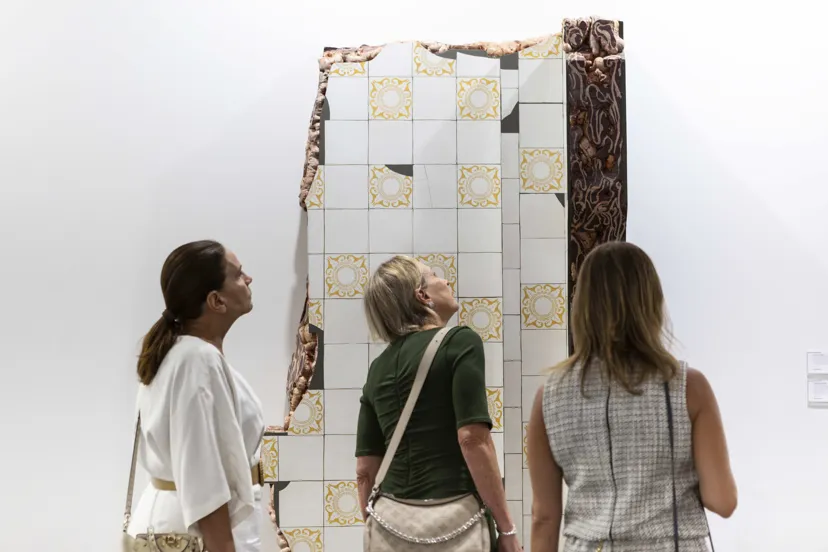
I want to continue celebrating women artists at this fair, so now I’d like to turn to a contemporary genius, Adriana Varejão, also exhibiting with Flexa. This is a rare opportunity to buy Varejao’s work, which in high demand at the moment, just one month before she opens in Venice at the Brazilian Pavilion. Varejao is one of Brazil’s most celebrated contemporary artists, known for her multi-disciplinary practice that excavates the scars of Brazilian colonial history, combining beauty and brutality in equal measure. At Flexa, you’ll encounter a triptych titled Monocromo Branco #11, 12 and 13, from the year two thousand. The work represents Varejao’s signature exploration into cracked surfaces, working with oil and plaster. As always with Varejao’s work, I encourage you to think critically and deeply about this piece: what is erupting on the surface? What caused these surfaces to crack?
Up until now, I’ve focused mainly on Brazilian artists, but before I close off this section, I want to highlight some fantastic artists from Latin America, brought to the fair by the galleries Sur and RGR. Sur is one of Uruguay's premier art galleries based in Punta del Este. On booth A five, they will be showcasing the work of many wonderful artists, but one in particular stands out to me: Wilfredo Lam. Lam was a Cuban artist who expanded the horizons of modernism through his profound exploration of the beauty and diversity of black diasporic culture. He is currently the subject of a major retrospective at MoMA, showcasing his work across painting, drawing and sculpture. For SP Arte, Sur presents his powerful painting, Mujer Caballo, produced between nineteen forty-two and nineteen forty-six. The painting merges the figure of a woman with that of a horse, representing the spiritual unity between devotee and a deity in the Afro Cuban religion Lukimi. This work is a striking representation of Lam’s fusion of cubist geometric forms with Afro-Cuban sensibilities.
RGR, which will be located on F2, is a Mexico City-based gallery that brings another artist I admire, the Venezuelan Carlos Cruz-Diez. A popular artist within the Brazilian market, Cruz-Diez is one of the most important figures of Latin American kinetic and op art of the 20th century. His works invite us not to simply see colour but to experience it. You will have the chance to encounter a work from his physichromie series. This is part of a decades-spanning series that explores how colour is not static, but a living thing that shifts with the engagement of the spectator and the interaction with the environment.
PART 3: MY TOP PICKS FROM THE PRIMARY MARKET
I spoke about some of my top picks from the secondary market, so now I want to move into some of my highlights from the primary market. To begin, I want to focus on two artists whose journeys started not in fine art or formal academic institutions, but in Brazil’s street art and graffiti scene. These artists are Miguel Afa and Panmela Castro.
Miguel Afa is a fast-rising contemporary artist whose artistic journey started in two thousand and one by painting on the streets of the Complexo do Alemao, one of the largest favelas of Rio de Janeiro. According to Afa, graffiti is “the greatest painting school in the peripheries of the world.” His practice centres on marginalised bodies and is both poetic and overtly political. His paintings are characterised by their muted palette and brushstrokes, which carry gestures of memory and affection. Despite being an artist in the earlier stages of his career, he’s already part of important institutional collections such as the Perez Art Museum in Miami and Pinacoteca in Sao Paulo. For A Gentil Carioca’s stand in booth E4, Afa presents paintings that showcase a beautiful lightness of touch and a gentle warmth.
Panmela Castro is also from Rio de Janeiro and initially associated with the graffiti scene. She is an artist whose practice is rooted in exploring the female body and its relationship with urban space. Her works, which span video, performance, painting and objects, draw from her own lived experiences and from exchanges with other women. At Galeria Luisa Strina’s booth on E3, she presents a truly stunning painting titled Lélia Gonzalez Dois, from the artist’s series Retratos Relatos - Revisitando a História. This series shows portraits of pioneering women who have shaped the struggle for women’s liberation. In this portrait, Castro highlights a key leader in the struggle for black rights in Brazil during the 70s and 80s. With its loose brushwork, dripping paint marks, and exposed canvas, this portrait embodies the fierce and trailblazing spirit of Lélia Gonzalez.
I wanted to spotlight another artist from gallery Luisa Strina whose practice is quite different from Castro’s. I’m talking about Ile Sartuzi, who just this year joined the gallery’s portfolio, representing a major step in his blossoming career. You may have heard of him through his conceptual work, Sleight of Hand, which gained ample news coverage in twenty twenty-four. The work involved the artist removing a 17th-century coin from a British Museum display and replacing it with a fake one. Sartuzi later deposited the original coin in the museum’s donation box, which builds on themes that are at the core of Sartuzi’s practice: trickery, magic and theatre.
This provocative work stirred reflection on the complicity of museums in the colonial looting of cultural objects. Sartuzi’s work for this year’s SP Arte is a less elaborate, but equally intriguing composition of velvet and pushpins mounted on a wooden board. The piece is titled Composicao com Pseudo Abertura. The work references velvet curtains, a recurrent motif in Sartuzi’s practice that are often found in theatres. As always, this work provides us with no easy answers. What lies behind the velvet curtains? What drives us to want to peer behind what’s behind them?
I want to end this section with another bold and brilliant artist, Daniel Lannes, taking part in Orma Gallery’s stand on E13. Daniel Lannes is a painter known for his striking compositions that pull equally from the banal and the historic, and fuse high and low culture. His works challenge the hierarchies of visual culture and are profound investigations into dynamics of power and sex. He presents 15 works from his Safe Sex series, exhibited for the first time in 20 years. The series depicts the artist himself and others physically “engaging” with tropical fruits. The paintings are equally gestural and sharp, bursting with explosions of colour and a visceral energy that is simply unstoppable.
PART 4: CUTTING-EDGE BRAZILIAN DESIGN
To close this audio guide, let’s take a step into the Design section of the fair. This section has jumped from twenty-three exhibitors in 2016 to seventy-four in 2026. Interest in Brazilian design has steadily grown over the past few years, due to its high-class craftsmanship, innovative experiments with form, and the use of fine quality materials, many of which are native to Brazil.
This year’s fair contains modernist icons of design as well as contemporary pioneers. At Etel at DS fourteen, you’ll encounter new work by iconic furniture designer and architect Percival Lafer. Lafer made this new work a year ago. This year’s Etel stand is a celebration of his 90th birthday. Lafer’s practice is known for its unique combination of comfort, functionality and the prominent use of tropical woods. You don’t want to miss the opportunity to see a master who continues to show that his craft is timeless.
The Design Now section is a new addition to the fair and a gateway into independent Brazilian design. Here, you’ll encounter unique designers forging their own paths, without industry infrastructure or massive commercial backing. Amongst the most exciting names is Lilian Malta, a biologist by training. She works exclusively with bone china porcelain, a noble material which is highly durable and lightweight. I’m struck by the subtle, minimalist beauty of her productions, that feel profoundly in tune with nature.
Also catching my eye is Vinicius Siega, a Sao Paulo-based designer who has produced two unique works for the fair, based on a prestigious wood, which is scarcely available and practically not used in contemporary design anymore: solid jacarandá wood. These works are wonderful examples of the importance of treating such majestic materials with reverence, letting them shine without excessive adornment or intervention.
CONCLUSION
And that brings our audio guide to an end. The full version of this tour will be available at SP-Arte’s website, and a direct link can be found in the description of this episode.
I hope you enjoyed our whistle-stop tour!! The goal was to give visitors a taste of living with art. You can come in and be a part of it!
I wish you all an excellent fair and hope you make the most out of this thrilling edition. And I’ll see you at the fair!
Until then,
Isa Galvão