Existe uma árvore
Livia Debbane writes about “Existe uma árvore,” an exhibition presented within the Design Sector at SP-Arte 2026. In this edition, the show approaches modern and contemporary Brazilian studio furniture as a history of the trees of our territory.
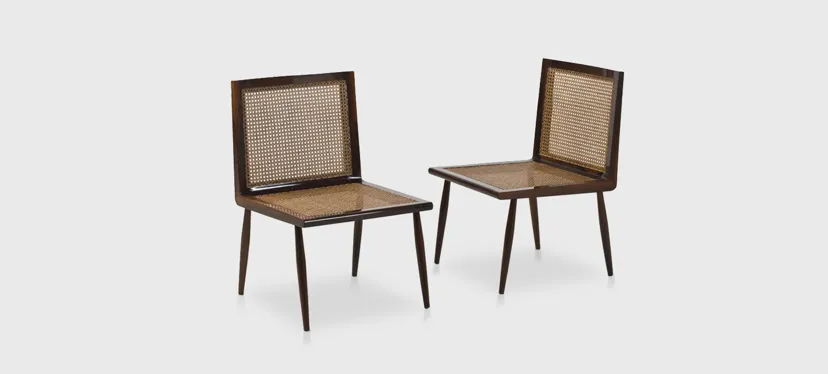
Cover: Low chair by Joaquim Tenreiro, 1950s. © Press
“We are amazed by the nobility of a tree—its eternal patience, its suffering caused by humans or sometimes by nature itself, its witnessing of thousands of years of Earth’s history, its creations of extraordinary beauty. It does only good, with its prodigious capacity to serve, releasing abundant oxygen while absorbing gases harmful to other living beings. Its fruits nourish us. Its branches give us shade and protection. And finally, when time and climate bring it down, its trunk provides wood for our homes and our furniture. The tree continues to live.”
This beautiful tribute to trees was written by George Nakashima, one of the great designers and woodworkers of the 20th century, in his book The Soul of a Tree. Having devoted his life to transforming wood into furniture, Nakashima saw himself as someone who breathes life back into the materials he works with—trunks, roots, planks—thus granting design a temporal dimension akin to that of the tree itself: spanning decades, centuries, even millennia. This close relationship with the material allows Nakashima, as well as any attentive woodworker, to perceive that every visible trace is an indication of the tree’s past life: the thickness of growth rings reveals the climatic conditions of each year—whether there was drought, flooding, or fire (the wider the rings, the better the growth cycle); knots indicate the presence of strong winds; and colors and their variations reflect the chemical composition of the soil.
In the book The Revolutionary Genius of Plants, part scientific outreach and part essay, Italian botanist Stefano Mancuso argues that the fundamental difference between plants and animals lies in one aspect: mobility. Plants are fixed; animals move. Over the course of evolution, this limitation led plant life to develop modes of existence and survival very different from those of bipedal, quadrupedal, winged, or aquatic beings. Among plants, trees in particular are anchored to the ground. Through their roots, they support themselves, seek water and minerals, and even communicate with neighboring plants through networks formed in symbiosis with fungi. Their leaves, as we know, carry out photosynthesis, removing “harmful gases” from the air and returning pure oxygen. Plants, Mancuso reminds us, operate through a modular logic with distributed structures; vital functions do not depend on a single organ, as in animals, but are spread throughout their entire bodies—hence their remarkable capacity for regeneration and resilience under the most hostile conditions. A tree is, at once, both living and dead: within the trunk, cells age from the center outward, transforming the heartwood into channels for the passage of water and nutrients—and into wood.
The arguments for keeping a tree standing are obvious: they generate only benefits. So why advocate for a practice that uses felled trees? It may seem counterintuitive to claim that design can act as an agent of preservation. Yet experience shows that, when conducted responsibly, extraction is not the enemy of the forest. Forest products, when properly managed, ensure—through their economic value—the survival of native biomes.

Stool by Oficina Umauma, by Fernanda Barretto. © Press
One of the factors that made modern Brazilian design among the most valued in the world was the use of native hardwoods. The 1950s and 1960s—when this production peaked with figures such as Joaquim Tenreiro and Sergio Rodrigues—were also marked by the exploitation of species that are now rare, above all the most famous of them, Dalbergia nigra. Commonly known as Brazilian rosewood, its chocolate tone, striking grain, and durability delighted designers of the period. But Dalbergia nigra also tells a story of destruction. In a past both recent and distant, what once seemed like an infinite resource was used to exhaustion, both within and beyond Brazil. Its exploitation in the region known as the Bahia Hileia—between northern Espírito Santo and southern Bahia, one of the most biodiverse areas on the planet—coincided with the last frontier of deforestation in the Atlantic Forest. Over the 500 years since the arrival of the Portuguese, this process decimated the coastal forest, reducing it to just 12.4% of its original extent, in varying stages of degradation. The rapid devastation of forests in southern Bahia was condemned by Zanine Caldas from the 1970s onward through his “protest furniture,” in which he used trunks that had survived burnings. Designers themselves witnessed this speed: whereas they once worked with solid rosewood, by the 1970s they had shifted to veneers or migrated to species such as mahogany, sourced from a region that soon became the new frontier of deforestation—the Amazon rainforest.
This history repeated what had already happened—or would happen—in the Atlantic biome with species such as brazilwood (Paubrasilia echinata), the Paraná pine (Araucaria angustifolia), the long-lived peroba rosa (Aspidosperma polyneuron), jequitibá (Cariniana spp.), and imbuia (Ocotea porosa). The causes ranged from agriculture and logging—for charcoal, construction, and furniture—to cattle ranching. Maurício Azeredo, an important designer and scholar, identified the phenomenon as the result of a “dictatorship of a single wood,” referring to consumer market preferences for just one species. Even in the mid-1970s, as a professor at the University of Brasília (UnB), he joined the Forest Products Laboratory of Ibama, located on the campus, to research the many species marginalized by this extractive process. After the “protagonist” trees were removed, the remaining forest was burned. “We lost the opportunity to learn about countless species, wiped out without any knowledge of their potential uses,” he noted. Since then, Azeredo has made his furniture a vehicle for promoting the botanical biodiversity of Brazil.

“Ressaquinha” bench, by Maurício Azeredo, 1988. © Press
The designer used up to 30 types of wood in a single piece of furniture, out of approximately 80 species researched from his wood collection, which formed the basis of his activism. He was also among the pioneers in articulating one of the pillars of sustainable forest management: rotational harvesting. Broadly speaking, managed areas are divided into subareas where the number of trees of each species that may be felled is controlled, along with a rotation among these zones. The basic principle is to maintain forest density and diversity. After all, the time required to cut down a tree—especially with the advent of the chainsaw—is infinitely shorter than the time it took for that tree to grow. This is an unavoidable fact: Amazonian sucupira takes about 90 years to reach maturity, while rosewood takes more than 200.
Another important path in response to this reality was forged by Carlos Motta. In the 1970s, he began designing his first pieces from logs and planks washed ashore on the beaches of São Paulo’s coastline, as well as from his contact with caiçara communities—their canoes, paddles, and vernacular constructions. From that point on, his work has advocated the use of so-called “rediscovered woods”: reclaimed beams, pillars, and foundations from demolished buildings, through which he was able to recover true treasures of the Atlantic Forest.

“Mandacaru” bench, by Carlos Motta, 2010. © Press
It is impossible to be a furniture designer working with wood without taking into account the history of trees in Brazil. The scenario today is different, of course, despite ongoing deforestation, illegal logging operations, and unlawful transport in the Amazon—whether driven by the search for high-value timber, agricultural and cattle expansion, or the damaging practice of land grabbing. Today, it is mandatory to have a Forest Origin Document (DOF), which certifies whether the planks reaching local markets come from sustainable management—such as those bearing the rigorous FSC seal. Reclaimed wood from demolished buildings or trees that have recently fallen in urban or rural areas are another legal source of raw material. Hugo França, for example, works exclusively with the latter.
All of these deeply compelling and urgent issues form the backdrop of the exhibition “There Is a Tree” at SP-Arte 2026. In addition to the designers already mentioned in this text, the show will feature furniture by Etel Carmona, Claudia Moreira Salles, Marcenaria Baraúna, Morito Ebine, Rodrigo Calixto, Fernando Mendes, Ricardo Graham, Julia Krantz, Zanini de Zanine, Rodrigo Silveira, Guilherme Sass, and Fernanda Barretto, produced using more than 20 Brazilian species. What these designers share is a direct relationship with woodworking—either as artisans themselves or through trajectories closely tied to craft traditions. They are creators whose experience has taught them to revere this raw material that, above all, was once a tree.
Exhibitors
Carlos Motta
Claudia Moreira Salles
Etel Carmona
Fernanda Barretto
Fernando Mendes
Guilherme Sass
Hugo França
Joaquim Tenreiro
Julia Krantz
Marcenaria Baraúna
Maurício Azeredo
Morito Ebine
Ricardo Graham
Rodrigo Calixto
Rodrigo Silveira
Sergio Rodrigues
Zanine Caldas
Zanini de Zanine

“Serena” armchair, by Claudia Moreira Salles for Etel, 2012. © Press